
Albania’s Final EU Countdown Has Begun. Most Companies Are Still Asleep.
May 2026
Albania Is Disbursing EU Reform Funds Faster Than Any Neighbor — While Its Corruption Ranking Fell 11 Places
June 2026
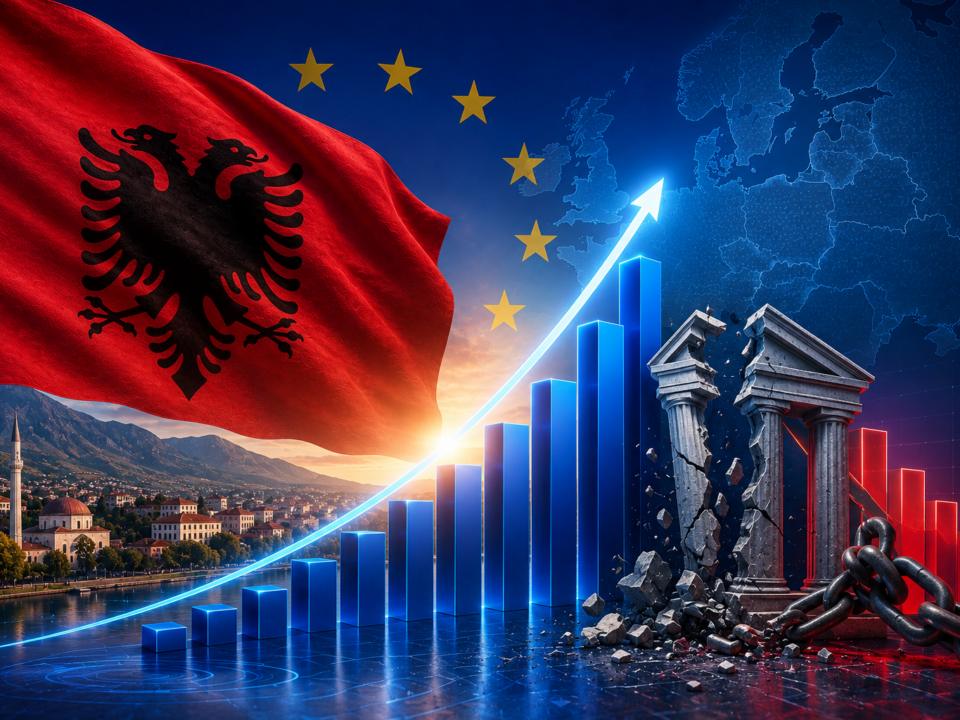
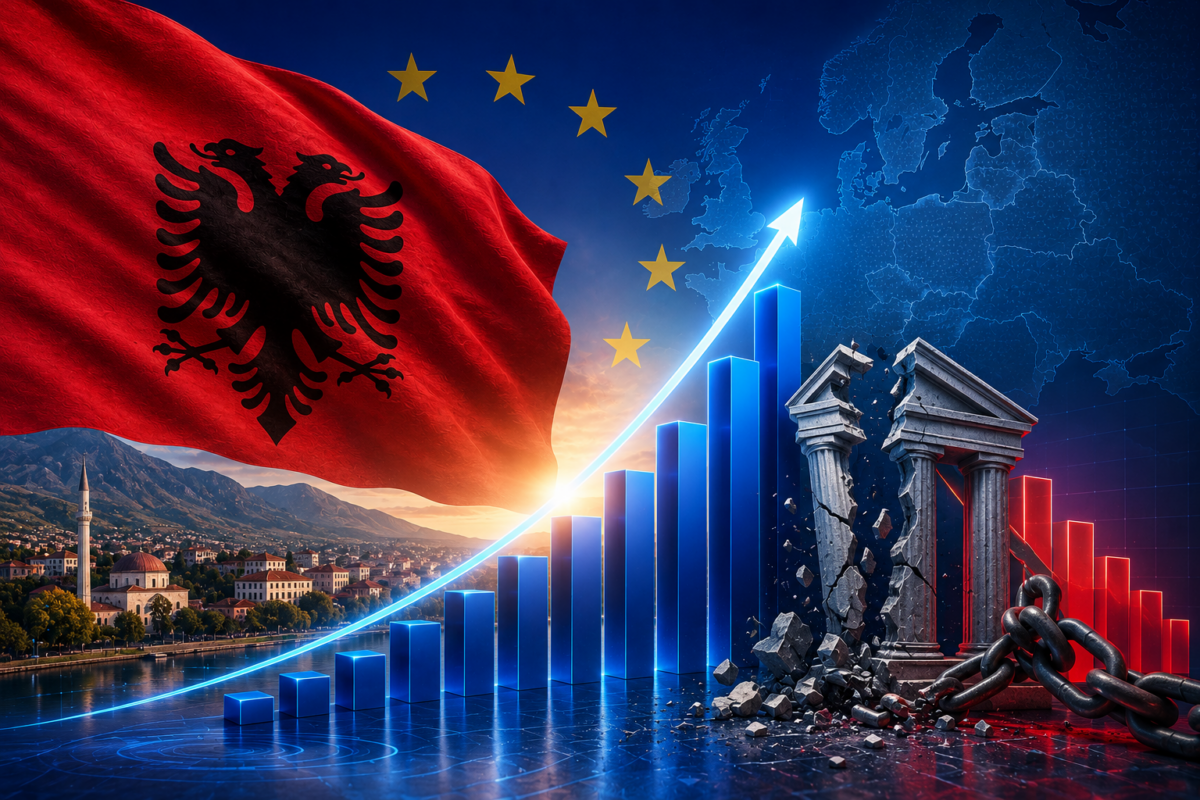
On May 26, 2026, in Brussels, something happened that most business newspapers didn’t cover — and almost every serious investor watching the Western Balkans should have noticed. At the eighth Intergovernmental Conference between the EU and Albania, Commissioner Marta Kos confirmed that Albania had officially transitioned into the concluding phase of EU accession negotiations — meaning it can now begin closing chapters, not just opening them. Albania became only the second candidate country in history, after Montenegro, to reach this stage.
This is not a procedural footnote. It is a structural signal — the kind that, in Central and Eastern Europe in the early 2000s, separated the investors who built lasting positions from those who arrived after the party started.
What “Concluding Phase” Actually Means
Most coverage of EU accession focuses on the political ceremony. What matters to a business strategist is what happens underneath.
When a candidate country enters the closing phase, three things converge simultaneously. First, EU institutional capital accelerates. In the same week as the May 26 conference, the European Commission released €49 million to Albania under the Reform and Growth Facility — bringing total disbursements to €212.8 million since the facility launched, with €922 million planned across 31 defined reform areas. Separately, EIB Group President Nadia Calviño traveled personally to Tirana in May to announce a €20 million SME financing package, and Albania was named the first beneficiary of the EU’s new Innovation and Green Transformation Facility for the Western Balkans. The EIB plans to increase its Albania financing by 60% in 2026 compared to the year before.
Second, regulatory convergence becomes irreversible. The closing benchmarks for Cluster 1 — covering the judiciary, rule of law, and fundamental rights (Chapters 23 and 24) — are now formally set. These are the chapters that define the quality of a business environment: contract enforcement, anti-corruption frameworks, judicial independence. Albania has real gaps here, and we should be honest about that. But the direction is now locked in by treaty process. Companies that build compliance frameworks today will not be scrambling to retrofit them at membership.
Third, the competitive clock starts ticking. PM Edi Rama has set 2027 as the target for concluding negotiations; Commissioner Kos has indicated 2029 for actual membership. That is a three-year window during which the market remains under-priced relative to where it will be inside the bloc.
The Pre-Membership Advantage Nobody Talks About
Here is the counter-intuitive truth that most market-entry consultants won’t tell you: waiting for EU membership to invest in a candidate country is the most expensive approach.
Look at the historical pattern. Poland, Romania, the Czech Republic — the multinationals and private equity funds that built dominant market positions did so in the 1998–2004 window, not after accession in 2004 or 2007. By the time the EU flag was raised, commercial real estate had repriced, local talent had been absorbed, and partnership slots with credible local operators were no longer available at reasonable valuations.
Albania’s economy is already showing this dynamic. FDI reached a record €1.71 billion in 2024–2025. The technology sector is exporting €221.5 million in IT services annually. The Durana Tech Park opened in 2025 specifically to attract foreign IT businesses. And critically, the domestic market is still small enough that a well-positioned early entrant can achieve meaningful market share before competition scales.
What We Are Seeing on the Ground in Tirana
At TechBroker Albania, we spend our days at the intersection of international ambition and local reality. What we observe in 2026 is a market in genuine transition — one that still requires active navigation, not passive optimism.
The rule of law benchmarks are set, but enforcement is uneven. The talent pipeline is strong, but retention is a real challenge as young Albanians weigh EU mobility. The government is actively courting foreign capital, but bureaucratic complexity for market entry remains higher than it should be for a country this far into its accession journey.
These are not reasons to stay out. They are reasons to enter with a partner who understands the terrain — and to move while the asymmetric advantage still exists.
The Window Is Defined, Not Open-Ended
Commissioner Kos put it plainly in Brussels: “The toughest phase of the negotiations begins.” What she means is that the political will has been demonstrated; now comes the grind of closing 33 chapters. That process creates momentum, not uncertainty.
For international companies with any exposure to Southern European or Western Balkans markets, the question is no longer whether Albania is on a credible EU accession path. That question was answered on May 26. The question now is whether your organisation enters the final pre-membership window with a deliberate strategy, or waits until the premium has been paid by someone else.
Learn more about how we work or start the conversation here.
TechBroker Albania is a strategic business partner for international companies and investors entering Albania and Kosovo. We provide market intelligence, partnership matchmaking, and on-the-ground advisory. Read more about us.