
Albania Just Entered the Final Phase of EU Accession. The Smart Investors Already Know What That Means.
June 2026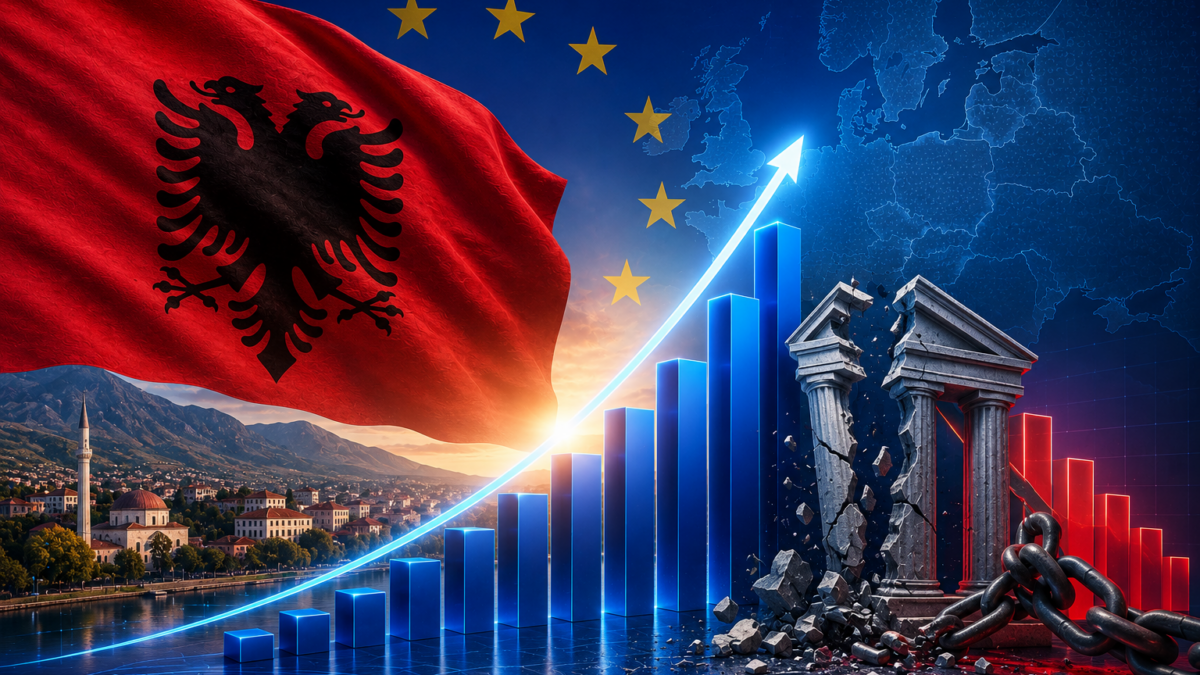
Two things happened in Albania last weeks. One made headlines across Brussels and Tirana. The other deserves more attention than it received.
On May 21, the European Commission released €49 million to Albania under the EU Growth Plan for the Western Balkans — part of a wider €158.9 million package to Albania, Montenegro, and North Macedonia. Quietly buried in the announcement was a detail that experienced investors should note: Albania is the top performer among all Western Balkans countries in EU Growth Plan implementation, having secured €163.8 million in cumulative disbursements and leading the region on reform delivery, number of measures fulfilled, and overall pace.
And yet: in Transparency International’s 2025 Corruption Perceptions Index, Albania fell 11 places — landing at 91st out of 182 countries.
Both of these things are simultaneously true. Sitting with that tension is what good market intelligence actually looks like.
What the EU Is Actually Measuring
The EU Growth Plan’s Reform and Growth Facility does not disburse money on goodwill. It disburses money when specific reform milestones are documented and verified. The reforms Albania completed to unlock this round included: measures to improve the business environment, expanded access to finance for startups and companies operating in the green and digital sectors, progress in sustainable transport infrastructure, and advancement in clean energy deployment.
These are technical, institutional reforms. They are measurable. The Ministry of Finance can be held accountable for whether a specific piece of digital public procurement legislation was enacted. The EBRD can verify whether a solar project permit framework was streamlined. The EU does this work rigorously before it transfers a single euro.
What the TI Corruption Index measures is something different: the perception of corruption among business people, country experts, and risk analysts who interact with the system. It captures the experience of waiting three months for a license, of watching a tender awarded to a politically connected party, of a minister proposing a law in February 2026 that would prevent his own prosecution while under criminal investigation.
Both measurements are valid. They are measuring different layers of the same country.
The Structural Divide That Investors Must Understand
Here is the insight that gets missed in both the cheerleading and the pessimism about Albania: the gap between institutional-technical reform and political-executive accountability is widening — not narrowing.
The technical apparatus is improving. Over 95% of public services are online through the e-Albania platform. More than 66% of judges and prosecutors have now passed the vetting process. Digital land registries are operational. The Constitutional Court is functioning. The EU Growth Plan money is flowing precisely because these technical deliverables are being met.
But at the political level, the European Parliament’s latest report documented “persistent pressure on the judiciary,” including by senior government officials. SPAK — Albania’s Special Anti-Corruption Prosecution, the institution that the EU specifically created as a condition of accession progress — has faced sustained institutional pressure when pursuing politically sensitive cases. Albania’s score on TI’s index fell at the same time that its EU accession timeline accelerated. That is not a contradiction. It is a structural feature.
This matters for foreign companies in a very practical way. Where you sit in relation to the political-executive layer determines your risk exposure.
A German renewable energy company co-investing with the EBRD in a solar project under the EU Growth Plan is operating in the institutional-technical layer. Their legal framework is anchored to Brussels. Their permits go through a regulated process with EU co-monitoring. Their risk profile is substantially different from a real estate developer who needs discretionary municipal approvals, or a media company, or anyone whose contract depends on a public institution exercising judgment rather than following a checklist.
The Sectors Where the Risk Profile Is Actually Manageable
We would be doing our clients a disservice if we translated “there is corruption in Albania” into “Albania is too risky.” That is lazy analysis, and it points away from the companies already operating profitably in the market.
Renewable energy is structurally de-risked in the current environment. Albania produces 100% of its electricity from renewables (95% hydro) and must rapidly scale solar and wind to meet its binding national target of 54% non-hydro renewables by 2030. Major European players — Voltalia, EBRD-backed funds, EIB project frameworks — are already engaged. Entry into this sector is increasingly institutional rather than speculative.
ICT services and digital outsourcing sit firmly in the technical-institutional layer. Contracts are commercial, not public. The Durana Tech Park, which opened in Tirana in April 2025, is specifically designed for foreign IT businesses. The 40,000+ ICT professionals in a country of 2.8 million constitute a talent pool that competes effectively on price and quality at the mid-market.
EU-funded infrastructure supply chains — logistics, construction materials, engineering services — benefit directly from the €922.1 million Growth Plan envelope allocated to Albania through 2027. €429 million comes as direct budget support; €265 million through the Western Balkans Investment Framework as grants; €228 million in concessional loans for infrastructure. The projects are real. The procurement, when tied to EU disbursements, is EU-standard.
Tourism and hospitality have their own political exposure, but the macroeconomic fundamentals are strong and EU accession adds a significant legitimacy premium that foreign investors in this sector have historically underestimated.
What TechBroker Is Actually Telling Our Clients This Week
The honest answer to “is Albania the right market right now” is: it depends on what layer you’re entering, who your counterparts are, and whether you have the intelligence infrastructure to distinguish between the two Albanias — the one that is a top EU reform performer, and the one that fell 11 places in the corruption index.
These are not contradictions. They are co-existing realities. Navigating them requires more than reading the Brussels conference press release — or the Transparency International report. It requires current, sector-specific, on-the-ground intelligence.
That is exactly what we provide. Learn more about how we work or start the conversation here.
TechBroker Albania provides market entry strategy, business matchmaking, and strategic advisory for international companies and investors entering Albania and Kosovo. Read more about us.